Oil Pastel or Soft Pastel? Reading the Marks
Learn to tell oil pastel from soft pastel by reading edges, texture and colour deposits, so you can identify how each medium shapes a drawing.
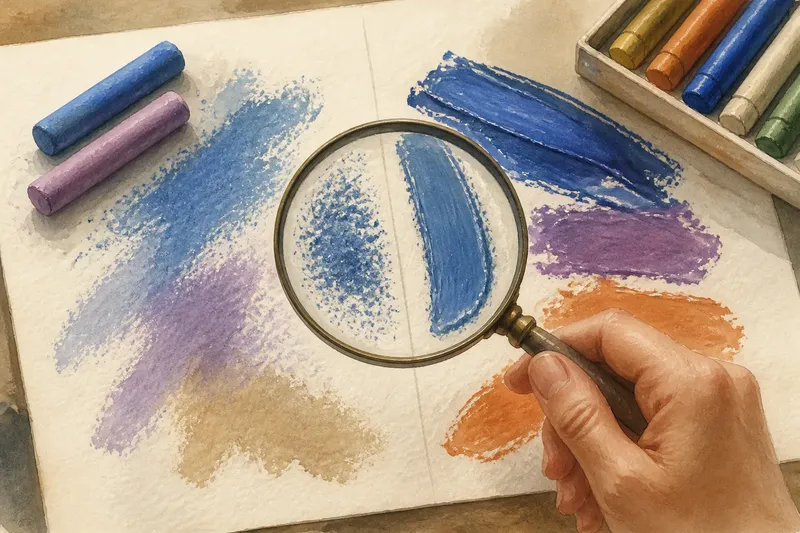
Oil pastel or soft pastel: the quickest clue is how the mark sits on the surface. Oil pastel tends to leave a dense, waxy-looking deposit that can be pushed into a continuous layer; soft pastel usually leaves a dry, powdery mark with loose particles around its edges. Read those clues together rather than relying on colour alone.
What is the visible difference between oil pastel and soft pastel?
Soft pastel is made with pigment held together by a small amount of binder, so its colour often looks dry and velvety. A stroke may release particles that settle into the paper’s tooth, the fine texture that gives the pigment somewhere to catch. Oil pastel contains pigment in a more substantial waxy or oily binder. Its strokes tend to look compact, slightly slick or creamy, even when the surface has a rough texture.
Look for the boundary of a stroke. Soft pastel may break into flecks where it crosses a ridge in textured paper, while oil pastel often forms a more continuous line across the same kind of surface. Neither appearance is absolute: pressure, paper, formulation and later handling all affect the result.
It can help to think of the difference as chalk dust compared with a wax crayon rubbed firmly onto paper. The analogy is only a starting point: artists’ pastels vary, and soft pastel is not simply school chalk.
How can you recognise each medium from a close-up?
Start with the surface, not the subject depicted. A close-up photograph or original drawing may reveal whether colour sits in loose, granular deposits or in a denser film. Check several areas, especially where strokes overlap, stop abruptly or meet an exposed patch of paper.
- Edges: Soft pastel commonly produces feathered or broken edges, especially with a light touch. Oil pastel more often leaves a defined ridge or blunt end, though a rubbed stroke can soften its outline.
- Surface sheen: Oil pastel may catch light with a mild sheen, while soft pastel generally looks matte. The amount of sheen depends on the material and the viewing light.
- Loose pigment: Dusty-looking particles and colour caught in paper grain suggest soft pastel. A cohesive, waxy-looking layer suggests oil pastel.
- Layer boundaries: Soft pastel can leave underlying marks visible through a light application. Oil pastel laid down heavily may cover them with a more opaque, compressed-looking layer.
Do not treat any single clue as proof. A photograph can flatten texture, and a fixative or protective surface can alter how a pastel looks. If you are examining an original, view it from more than one angle without touching it.
Why does soft pastel leave a dusty, broken mark?
Soft pastel’s relatively dry binder lets pigment transfer from the stick to the support with little pressure. On paper with a pronounced tooth, particles lodge in the texture and create a grainy, broken stroke. A gentle pass can leave the paper visible between deposits, so the drawing may feel airy even where the colour is strong.
Artists can spread or soften these marks by rubbing them with a finger, cloth or blending tool. That reduces the crispness of the original stroke and can mix nearby colours into a haze. A firm line made with the edge of the stick, by contrast, can remain sharply legible against a softer passage.
Soft pastel’s loose surface also makes exposed paper part of the image. A pale gap can be an intentional reserve rather than an unfinished patch. When reading a drawing, notice whether the artist uses those gaps to separate colours, create highlights or let the support’s own tone contribute.
Why does oil pastel look thicker or more continuous?
Oil pastel’s binder helps the pigment hold together as it transfers. A stroke can look creamy, dense or slightly raised, and firm pressure may leave a visible ridge. Layering often builds a compact surface rather than the loose, dust-like deposit associated with soft pastel.
Artists can drag a stick over an existing colour, press a second colour into it or scrape into a built-up area to expose what lies below. These actions can make the surface look worked and physical. If the marks appear smeared or blended, look for whether the colours have merged into a smooth film or remain as distinct, waxy strokes.
Oil pastel is not automatically glossy or smooth. On toothy paper, its marks can skip across the high points, and a light application can leave a broken line. The medium’s characteristic density is a tendency, not a fixed finish.
What can the support tell you about the pastel marks?
The support—the paper or board beneath the pigment—shapes what each stick can leave behind. Rough paper has more visible tooth, which can hold soft pastel particles and interrupt a lightly applied oil pastel stroke. Smoother paper may allow a more continuous line, but it can offer less grip for dry pigment.
Colour also changes the reading. A toned sheet may remain visible through thin passages, while a pale sheet can make dark marks appear especially crisp. Look for exposed ground between strokes and ask whether it is an accident, a deliberate reserve or simply the effect of the artist’s chosen pressure.
In an invented example, say you see a blue drawing on warm grey paper. If the blue sits in dusty patches that leave the ground visible and the edges soften into the sheet, soft pastel is a plausible reading; if the blue forms a compact, slightly waxy band with a raised edge, oil pastel is more likely. The material cannot be identified with certainty from appearance alone, but those observations give you a reasoned starting point.
How do overlapping marks reveal the artist’s handling?
Overlaps show what happens when one mark meets another. In soft pastel, a fresh stroke may sit on top of an earlier passage or blend into it when rubbed. Look for layers that retain a granular edge beside areas where colour has been spread thinly.
In oil pastel, overlapping colours can remain visibly stacked, with the later stroke forming a denser band. Scraped lines or gaps may expose a lower layer or the support. The direction and pressure of each stroke can remain legible, letting you read the artist’s hand as a sequence of deposits rather than a single even fill.
These effects can also occur in mixed-media work. A drawing might combine soft pastel with pencil or oil pastel with another material, so a change in texture does not always mean a change from one pastel type to the other. Compare marks that share the same colour or direction before deciding what the surface is doing.
How should you interpret uncertain pastel marks?
Begin by describing what is visible: matte or slightly reflective, broken or continuous, loose or compact. Then consider the paper’s texture, the pressure of the stroke and whether the area appears rubbed, layered or scraped. This keeps observation separate from guesswork.
If you are looking at a reproduction, remember that lighting, camera focus and image processing can hide surface texture. A close detail may make an ordinary paper grain look like pigment, or make a subtle sheen disappear. Museum labels and conservation notes can clarify the materials, but do not infer a medium from a screen image alone.
Which clues answer common questions about pastel marks?
Can oil pastel and soft pastel be used on the same paper?
Both can be used on suitable papers, but the surface affects them differently. A toothy support can hold soft pastel and give oil pastel texture; a smoother one may produce more continuous marks but can be less receptive to loose dry pigment.
Does soft pastel always smudge more easily?
Its loose particles can shift when disturbed, so smudging is a common visual clue. The extent depends on the paper, the pressure and any protective treatment, so do not use smudgeability alone to identify a work.
Can you blend oil pastel like soft pastel?
Oil pastel can be blended by working one colour into another, but the result tends to remain more cohesive and waxy-looking. Soft pastel often blends into a softer, powdery haze when rubbed.
Can you identify the medium from a photograph?
Sometimes the photograph shows useful clues, such as loose pigment, a visible ridge or a matte surface. Treat the identification as provisional because reproduction can flatten texture and change apparent sheen.
What is the most reliable way to read the marks?
For oil pastel or soft pastel, combine clues rather than looking for a single signature. Consider the edge, surface, exposed paper, layering and signs of rubbing or scraping, then ask how those choices contribute to the drawing’s appearance. The distinction matters because it shifts your attention from naming a stick to seeing how pigment meets paper.
When the evidence remains mixed, describe the marks precisely instead of forcing a label. “A dense, waxy-looking blue stroke with a raised edge” tells another viewer what you can see; it also leaves room for the possibility of a blend of materials. That is often the clearest reading the surface can offer.