Printmaker’s Proofs: How Test Impressions Reveal an Image’s Development
Printmaker’s proofs reveal how an image changes in the workshop, helping you distinguish alterations to a matrix from variations in ink, paper and printing.
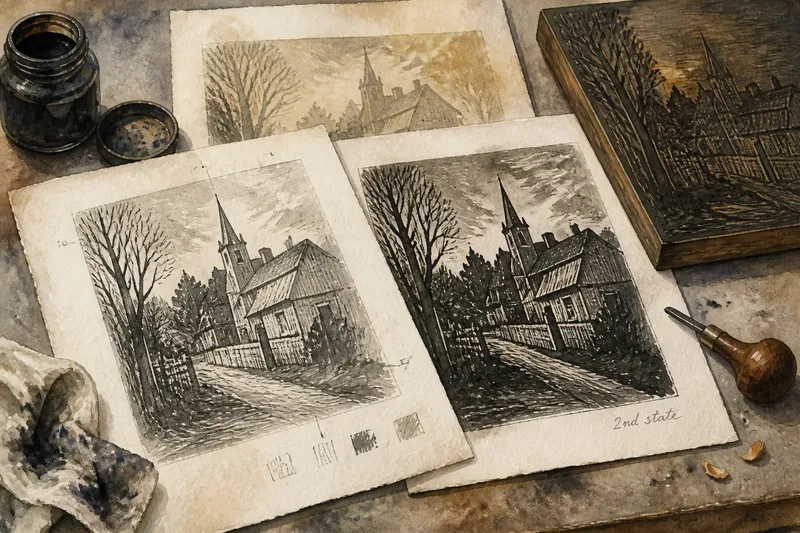
Why keep a print that is not part of the finished edition? A printmaker’s proof can preserve decisions made while an image is being developed, from a revised line to a change in inking. The term covers different practices across periods and collections, so the sheet’s marks, inscriptions and catalogue record need to be read together.
Think of a proof as a marked-up sketch beside a polished drawing: it can show what the artist was considering, but it needs context. Here are five ways proofs help viewers understand how a print took shape.
A printmaker’s proof makes the process visible
Printmaking transfers an image from a matrix to paper. The matrix might be a woodblock, an etched metal plate or a lithographic stone. An impression made to inspect or record the image can preserve choices that are difficult to see on the matrix itself.
A pale line might result from shallow cutting, inking or pressure; a dark patch might reflect how the plate was wiped. The impression records an outcome, but it does not identify the cause by itself. Compare the image with the process and other available impressions before drawing conclusions.
A proof lets the artist judge the image on paper
A plate can look promising before printing, yet its impression may feel crowded, weak or unbalanced. On paper, the artist can judge how line, tone, ink and support work together. The impression may prompt a change to the matrix, or confirm that a mark is doing its job.
Printing can also reverse or transform what the artist sees while working. A cut line on a block, for example, may appear as a light line within a dark field. An impression lets the artist assess the image in the form a viewer encounters.
Proof labels describe different roles and stages
Proof terminology varies by institution, period and printing tradition. Labels such as working proof, trial proof and state proof are not used consistently everywhere, and their meanings can overlap. Treat them as clues about a sheet’s role or relationship to the matrix, not as universal categories with fixed boundaries.
In some catalogues, a working or trial proof refers to an impression made while the image is being assessed. A state proof is commonly associated with a particular version of the matrix, but the exact usage should be checked against the collection’s terminology. A printer’s proof or artist’s proof may describe an impression reserved for a printer or artist; neither label alone tells you when it was printed.
When reading a catalogue entry, separate three questions: what changed in the matrix, what purpose the impression served, and how it relates to an edition. An inscription can help, but it is evidence to interpret rather than a complete production history.
Comparing states can reveal an artist’s priorities
When a printmaker alters a matrix, impressions from before and after the alteration may be described as different states. Comparing them can show where attention shifted. A figure may be sharpened, a background darkened or a distracting line removed. The later state is not automatically more successful; the change shows a decision and invites you to consider its effect.
Say an invented woodcut begins with a figure whose sleeve disappears into a dark background. The artist cuts a narrow line into the block and pulls another impression; the sleeve becomes easier to distinguish while the surrounding dark remains. Comparing the two sheets reveals the starting problem, the specific alteration and its visible result, without requiring you to assume the later image is better.
Look at contours, dark areas, lettering and empty spaces. If a line has changed shape or position, that may support the idea of a matrix alteration. If the main difference is overall tone or paper colour, consider printing conditions before calling it a new state.
Proofs preserve variation that editions can conceal
Impressions made from the same matrix need not look identical. Ink may sit differently on a plate, wiping may vary, and paper may receive the image differently according to its condition. A proof can preserve an unusual combination of matrix, ink and paper.
Variation is not automatically evidence of revision. A changed line may indicate an altered matrix, while a tonal shift may result from inking or wiping. If other impressions are available, compare them and consult the catalogue’s account of the print’s states and production.
What can a printmaker’s proof tell you?
How does a proof differ from an edition impression?
A proof is identified by its role in checking, recording or setting aside an impression, not simply by how finished it looks. An edition impression may also have been inspected during production, so the catalogue and object history matter.
Does every proof show a mistake?
No. An impression may document a change, confirm a result or be retained for an artist or printer. Its significance lies in what it records, not in presumed failure.
Can you identify a proof from appearance alone?
An unfinished area or altered line may offer a clue, but appearance cannot establish the sheet’s role on its own. Inscriptions, collection records and comparison with other impressions can help clarify its relationship to the matrix and edition.
What should you make of inscriptions and numbers?
Written marks may identify a state, recipient or place within an edition practice. Read them alongside the image and catalogue record, since conventions differ and an inscription may have been added after printing.
Use visible evidence to read a proof carefully
Begin with what you can see: a changed contour, a shift in tone, an inscription or a difference in paper. Ask whether the evidence points to an altered matrix, a printing choice or a label applied later. For a printmaker’s proof, keeping those possibilities separate makes the sheet a more reliable record of how the image developed.
- Check whether a contour differs in shape or position; if it does, compare another impression for a possible matrix change, and if it does not, consider inking or paper variation instead.
- Check whether tonal differences are confined to a dark area; if they are, consider wiping or ink distribution, and if lines also change, examine whether the matrix may have been altered.
- Check the paper tone and surface; if they differ, allow for a change of support, and if they match, compare the printed marks rather than assuming the impressions are identical.
- Check for lettering or small details that appear or disappear; if their form changes, consult the catalogue’s state description, and if they remain stable, look for other evidence before assigning a state.
- Check inscriptions for terms such as “proof” or “state”; if present, compare them with the collection record, and if absent, do not rule out proof status based on appearance alone.
- Check whether the catalogue describes the sheet’s role or only its matrix state; if it names a role, keep that distinct from the version of the image, and if it gives only a state, avoid inferring who retained the impression.